

Use & Care NotesLavender Plants
Miss Muffet Lavender: A Dwarf English Lavender for Tight Spots
 Save
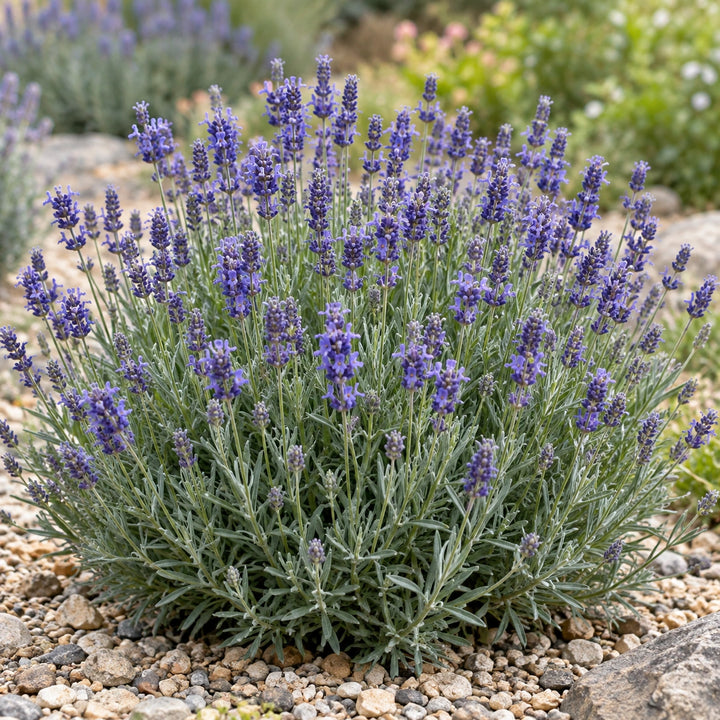
Miss Muffet lavender is a true dwarf. It grows into a compact mound only about 12 inches tall and 20 inches wide, with gray-green foliage and violet-blue spikes that pack a powerfully aromatic English lavender scent. It holds the Royal Horticultural Society's Award of Garden Merit and is sometimes listed under the name Scholmis.
No tuffet required. It is happy on a sunny windowsill box, a patio pot or the very front of a border.
Miss Muffet at a glance
| Trait | What to expect |
|---|---|
| Botanical name | Lavandula angustifolia 'Miss Muffet' |
| Flower color | Violet-blue |
| Habit | Dwarf and compact |
| Size | About 12 inches tall and 20 inches wide |
| Bloom | Begins late June to mid-July, peaking early July to mid-August depending on source and climate; moderate rebloom |
| Hardiness | USDA zones 5a to 8b; RHS hardiness rating H5 |
| Fragrance | Exceptional, powerfully aromatic |
| Recognition | RHS Award of Garden Merit |
Where a dwarf lavender earns its place
Small lavenders solve problems big ones create. Miss Muffet will not swallow a path, block a low window or crowd out its neighbors. Use it to edge a walk, line the front of a raised bed, fill a strawberry pot or soften the base of taller perennials. A single plant in a terracotta pot by the door is enough to scent the entry in bloom.
For a low hedge, space plants 18 to 20 inches apart so they meet into a neat ribbon.
Container growing tips
- Choose a pot at least a few inches wider than the root ball, with drainage holes.
- Use a gritty, fast-draining mix rather than heavy garden soil.
- Water when the top inch or two is dry. Pots dry faster than beds, but soggy soil is still the bigger risk.
- Set the pot in the sunniest spot you have, six to eight hours or more.
- In cold winters, potted roots are more exposed than roots in the ground. Group pots against a sheltered wall or move them to an unheated, protected spot where the soil stays on the dry side.
Care in the ground
Plant in full sun with sandy or loamy soil that drains well. Set the crown level with the soil surface and keep mulch away from the base. Water deeply through the first season, then only in long dry spells. Shear lightly after the main bloom, staying above the woody base; a light trim keeps a dwarf lavender dense and encourages a moderate rebloom. The Pruning Calendar lays out the timing.
Harvest and uses
Miss Muffet is rated great for culinary use and excellent for essential oil suitability. Its short stems are best for buds rather than long bundles: cut when spikes are colored and only a few flowers are open, dry in the shade and rub off the buds for baking, sugar or sachets. Use only plants grown and handled as a food crop, and start small, since the scent is strong.
It is offered as 3-inch plugs, 4-inch pots and 1-gallon pots. See the product page for current sizes and availability.
Frequently asked questions
How small does Miss Muffet stay?
About 12 inches tall and 20 inches wide at maturity, which makes it one of the smaller English lavenders.
Can it live in a pot year-round?
Yes, with good drainage and full sun. In cold climates, give potted plants winter shelter from soggy soil and harsh wind.
When does it bloom?
Sources place its start between late June and mid-July, with peak bloom from early July into August. Climate and planting time shift it.
















Share how it went in your field