

Use & Care NotesLavender Plants
No. 9 Lavender: A Dense, Upright English Lavender All-Rounder
 Save
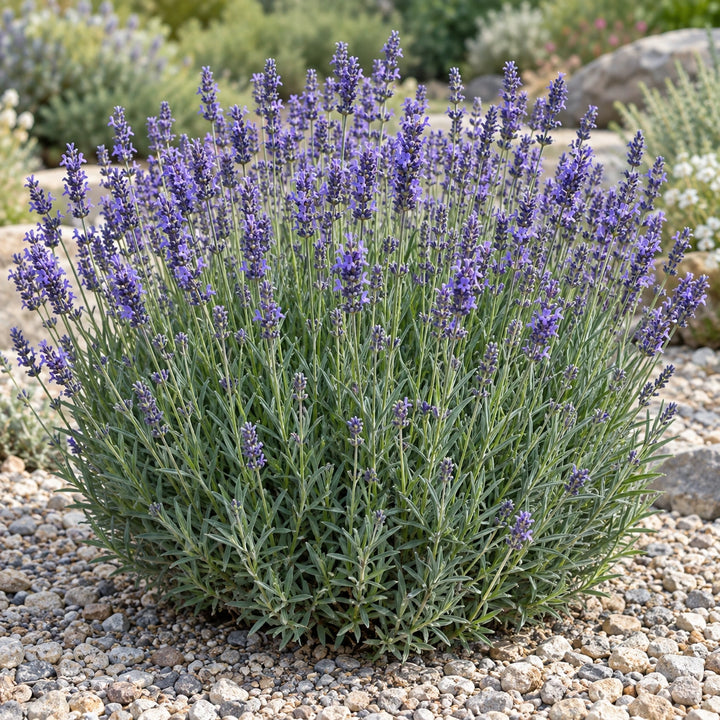
No. 9 lavender may have the plainest name in the catalog, but the plant itself is easy to like. It is an English lavender with purple-blue to violet-blue spikes over gray-green foliage, forming a dense, upright, mound-shaped plant about 24 inches tall and 28 inches wide.
It sits right in the middle of the English lavender size range: big enough to make a statement in a border, small enough to fit almost anywhere.
No. 9 at a glance
| Trait | What to expect |
|---|---|
| Botanical name | Lavandula angustifolia 'No. 9' |
| Flower color | Purple-blue to violet-blue |
| Foliage | Gray-green |
| Habit | Mound-forming, upright and dense |
| Size | About 24 inches tall and 28 inches wide |
| Bloom | Starts mid-June, peaks mid-July, moderate rebloom |
| Hardiness | USDA zones 5a to 9b |
| Fragrance | Sweet floral, soft herbal, low camphor |
Why a dense habit matters
Some lavenders open up in the middle after a few years, especially if pruning gets skipped. Dense, mound-forming types like No. 9 hold their shape better, which keeps a hedge or border looking full. Its upright stems also stand clear of the foliage, so the violet-blue color shows well from a distance. Use it as a low hedge, in a row along a fence, at the center of a herb garden or in groups of three in a mixed border.
Planting and spacing
Choose a site with full sun and fast-draining soil. Sandy or loamy ground is ideal; clay should be amended heavily or raised. Space plants about 24 to 28 inches apart for a hedge that just touches, or a bit wider for individual mounds with airflow between them.
Set the crown level with the soil, water the root zone deeply and keep compost and wood mulch away from the base. Confirm your zone with the USDA Zone Finder.
Care calendar
- Spring: trim off winter-damaged tips once new green growth appears.
- June: spikes color up; cut early stems for culinary buds.
- July: peak bloom. Cut for bundles when about a third of the flowers have opened.
- After bloom: shear to shape, staying in the leafy growth. A moderate rebloom may follow.
- Fall and winter: stop feeding, keep the crown dry and avoid heavy mulch.
The Care Calendar sends you through each step at the right time.
Harvest and uses
No. 9 is rated great for culinary use, with the sweet, low-camphor profile that suits baking, lavender sugar and syrups. Cut buds on a dry morning, dry them in the shade and store airtight. Use only plants grown and handled as a food crop, and start with small amounts. Its essential oil suitability is rated excellent, and the spikes are good for both fresh and dried bundles. Bees love it, and deer tend to pass it by.
It is offered as 3-inch plugs, 4-inch pots and 1-gallon pots. See the product page for current sizes and availability.
Frequently asked questions
Is No. 9 a good hedge lavender?
Yes. Its dense, upright, mound-forming habit makes a full, even hedge.
How does it compare to other English lavenders?
It is a mid-sized English lavender with violet-blue flowers and a mid-July peak. Line it up with others in the Compare tool.
Can I cook with No. 9?
Yes. It is rated great for culinary use. Begin with a pinch and adjust to taste.
















Share how it went in your field