

Use & Care NotesLavender Plants
Old English Lavender: A 1930s Lavandin with Two-Foot Stems
 Save
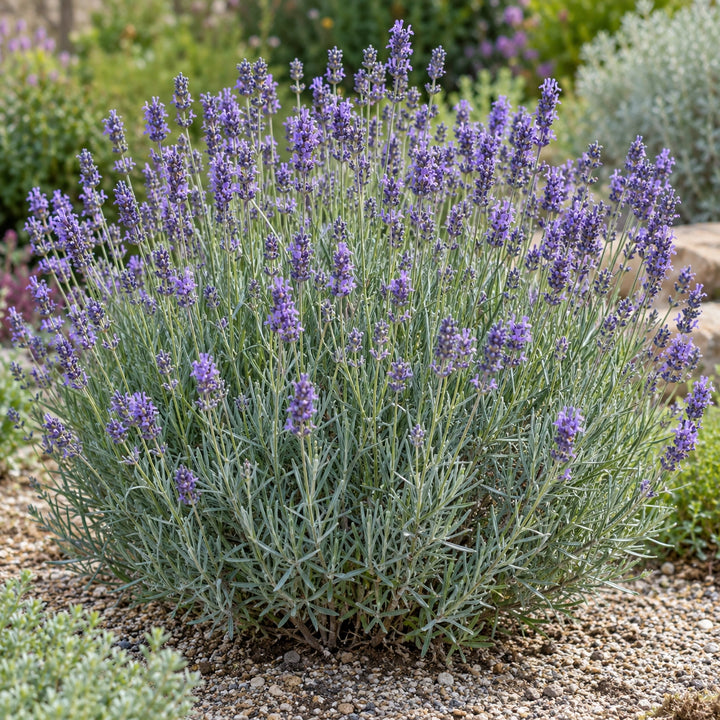
Despite the name, Old English lavender is not an English lavender at all. It is a lavandin, Lavandula × intermedia, a cross between English lavender and spike lavender dating to the 1930s. It grows into a vigorous, bushy, upright plant about 35 inches tall and wide, with silver-gray to gray-green foliage and pale blue-purple spikes on remarkably long stems, about 23 inches.
Those stems are the reason to grow it. Bundles practically make themselves.
Old English at a glance
| Trait | What to expect |
|---|---|
| Botanical name | Lavandula × intermedia 'Old English' |
| Parentage | L. angustifolia × L. latifolia |
| Flower color | Pale blue-purple to pale purple |
| Foliage | Silver-gray to gray-green |
| Size | About 35 inches tall and wide; stems about 23 inches |
| Bloom | Starts mid-July, peaks early August, one main flush |
| Hardiness | USDA zones 5a to 9b |
| Introduced | 1930s |
A name that confuses people
Gardeners often expect Old English to be a classic English lavender. It is a lavandin, so it behaves like one: bigger plant, longer stems, later bloom and a stronger floral-herbal fragrance with fresh camphor notes. If you want the sweetest culinary lavender, pick an English type. If you want tall, generous stems for wands, bundles and wreaths, Old English is a strong pick.
Planting a vigorous lavandin
- Sun: full sun, all day if possible.
- Soil: lean and fast-draining. Avoid rich, moisture-holding beds that make lavandins sprawl.
- Spacing: about three feet apart, or more in a field row, so air moves freely.
- Planting: crown level with the soil surface; water deeply after planting.
- Establishment: water through the first season when the top few inches dry, then rarely.
Check your zone with the USDA Zone Finder and timing with the Frost Date Estimator.
Harvest and pruning
Old English blooms from mid-July with an early August peak and puts on one main flush, so plan a single generous harvest. For dried bundles, cut when about a third to half of the flowers on each spike have opened, on a dry morning. Bundle loosely and hang upside down in a dark, airy spot. The long stems also suit lavender wands and wreath bases.
After harvest, prune the plant back into a rounded mound, staying above the woody base where green growth remains. A yearly trim keeps vigorous lavandins from splitting open in the center. The Pruning Calendar covers the details.
Other uses
It is rated excellent for essential oil and high oil production, excellent for fresh and dried flowers, and excellent for pollinators. Bees cover it in bloom. It is also rated good for culinary use, but lavandin flavor is stronger and more camphor-forward than English lavender, so use it very sparingly if at all in the kitchen. Deer generally avoid it.
Old English is offered as 3-inch plugs, 4-inch pots and 1-gallon pots. See the product page for current sizes and availability.
A tip for long stems: bundle Old English in small handfuls and secure them with a rubber band rather than string. As the stems dry and shrink, the band tightens with them and keeps the bundle from slipping apart.
Frequently asked questions
Is Old English an English lavender?
No. Despite the name, it is a lavandin, Lavandula × intermedia.
Does it rebloom?
Very little. It has one main flush from mid-July into early August.
How long are the stems?
About 23 inches, among the longest in the lineup, which is ideal for bundles and wands.
















Share how it went in your field