

Use & Care NotesLavender Plants
Opal Rain Lavender: Pink and White Blooms in Early Summer
 Save
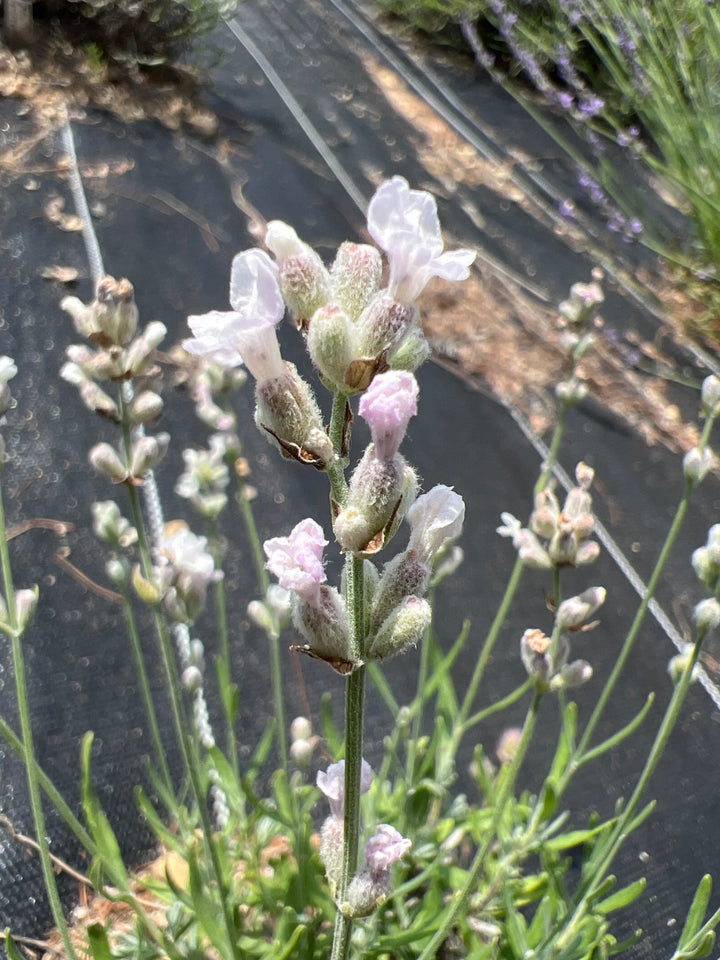
Opal Rain lavender brings a pastel mix to the English lavender bed: its flowers come in pink and white over gray-green foliage. The plant is bushy, compact and mounding, staying about 20 inches tall while spreading to around 36 inches, and it blooms early, from early June with a peak by mid-June.
The name suits it. In full bloom the soft colors shimmer a little, the way opals do, and nobody has to dust them.
Opal Rain at a glance
| Trait | What to expect |
|---|---|
| Botanical name | Lavandula angustifolia 'Opal Rain' |
| Flower color | Pink and white |
| Foliage | Gray-green |
| Habit and size | Bushy, compact and mounding; about 20 inches tall and 36 inches wide |
| Bloom | Starts early June, peaks mid-June, moderate rebloom |
| Hardiness | USDA zones 5a to 8b |
| Fragrance | Sweet floral, soft herbal, low camphor |
| Culinary | Rated great |
A soft, low ribbon of color
Opal Rain grows much wider than it is tall, so it works beautifully as a low, flowing edge or a groundcover-like planting on a sunny slope. Its pastel flowers soften hardscape and pair naturally with silver foliage, white stone and pale blue pots. In a mixed lavender bed, set it in front of deeper purple cultivars, where its light colors make the darker spikes look richer.
Its early bloom also gives pink and white color in June, before many purple English lavenders peak.
Planting and spacing
Give Opal Rain full sun and soil that drains quickly. Sandy or loamy soil suits it best, and heavy clay needs a raised bed. Because it spreads to about three feet, space plants roughly 30 to 36 inches apart so they meet without crowding. Set the crown at soil level, water deeply and keep organic mulch away from the base.
Plan your planting window with the Frost Date Estimator.
Care through the season
- Water: regularly in the first season when the top few inches are dry, then only in long dry spells.
- Feeding: minimal. Lean soil keeps the mound compact and the flowers plentiful.
- After bloom: shear lightly in late June or early July, staying in the leafy growth, to encourage a moderate rebloom.
- Fall: a final light tidy is fine, but leave enough foliage to protect the crown over winter.
- Winter: drainage, not cover, is what matters most.
Harvest and uses
Opal Rain is rated great for culinary use. Harvest in June when buds are colored but mostly unopened, dry in the shade and store airtight. Pale pink and white buds make a pretty, light-colored lavender sugar. Use only plants grown and handled as a food crop and start with small amounts. Its stems also work for small fresh posies and dried bundles, and its essential oil suitability is rated excellent. Pollinators visit it often, and deer usually do not.
It is offered as 3-inch plugs, 4-inch pots and 1-gallon pots. See the product page for current sizes and availability.
Because it blooms so early, Opal Rain is also handy for gift bundles and table posies in June, well before the midsummer lavender rush. Dry a few small bunches in the dark to keep the pastel tones as soft as possible.
Frequently asked questions
Are the flowers pink or white?
Both. Opal Rain's flowers come in pink and white, giving a soft pastel mix.
When does Opal Rain bloom?
Early: from early June, peaking by mid-June, with a moderate rebloom after shearing.
Is it a good edging plant?
Yes. Its low, wide, mounding habit suits edges, slopes and the front of borders.
















Share how it went in your field