

Product Field NotesCompanion Plants
Pincushion Ornamental Onion: Lilac Globes for Late Summer
 Save
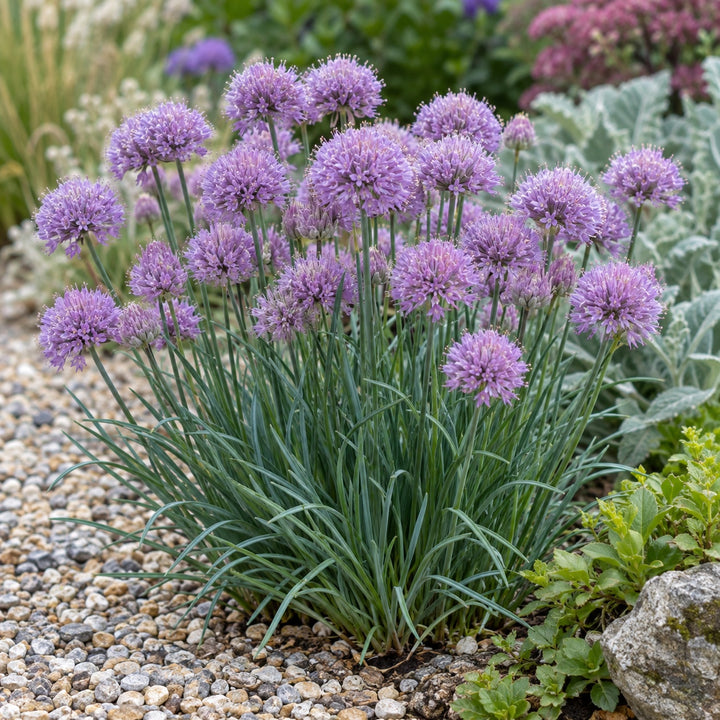
Pincushion ornamental onion is a small-scale Allium that produces a large number of rounded flower clusters, each about 1.5 inches across, made of tiny starry florets in soft lilac purple. They sit on slender, straight stems just above a tidy, upright tuft of narrow, glaucous blue-green leaves. At peak the plant is studded with little purple balls, like pins in a cushion.
At only 14 to 16 inches tall, it is sized for the front of a bed.
Pincushion at a glance
| Trait | What to expect |
|---|---|
| Botanical name | Allium 'Pincushion' |
| Flowers | About 1.5 inch lilac-purple globes |
| Foliage | Narrow, stiff, glaucous blue-green |
| Size | 14 to 16 inches tall, 12 to 14 inches wide |
| Bloom | Starts late July, peaks mid-August, long blooming |
| Hardiness | USDA zones 4 to 8 |
| Light | Full sun to part shade |
| Wildlife | Excellent for butterflies and bees; deer and rabbit resistant |
A color-matched edging
Pincushion grows in the same sunny, lean, well-drained soil as lavender, which already makes it an easy partner. The real appeal is the match: lilac-purple globes and blue-green leaves that look like they were chosen to go with lavender. Along the front of a lavender bed, they make a neat, tidy edge that stays in its lane.
Timing seals it. Pincushion opens in late July and peaks in mid-August, after the main lavender bloom, so the purple theme continues at the bed's edge while the lavender is being harvested or trimmed. It is also not known to reseed, so the edging stays exactly where you put it. Plan it in the Companion Plant Planner.
Planting and care
- Soil: lean to average and well drained.
- Water: regular the first season, then very drought tolerant.
- Foliage: stays tidy through summer in full sun. Leave it until it yellows, then cut back in late fall or early spring.
- Dividing: split clumps in spring every few years if desired.
- Winter: reliably hardy in Michigan in well-drained soil; no mulch needed.
Seed heads and cut flowers
Strong stems hold the heads upright through flowering and into seed, and the seed heads are attractive enough to leave standing. The flowers are good for both fresh and dried arrangements. Small purple globes and dried lavender make a pretty, all-purple bundle.
Good to know
The flowers are lightly scented, but the leaves smell of onion when crushed, which is part of why deer and rabbits avoid it. Like other onions, it is toxic to dogs and cats, so it is strictly ornamental.
Frequently asked questions
Is this a bulb?
It is a clumping ornamental onion sold as a bare root plant, planted like a perennial rather than a fall bulb.
Will it seed everywhere?
No. It is not known to reseed.

































Share how it went in your field