

Use & Care NotesCompanion Plants
Twinkle Toes Lungwort: Spring Blue for the Beds Lavender Avoids
 Save
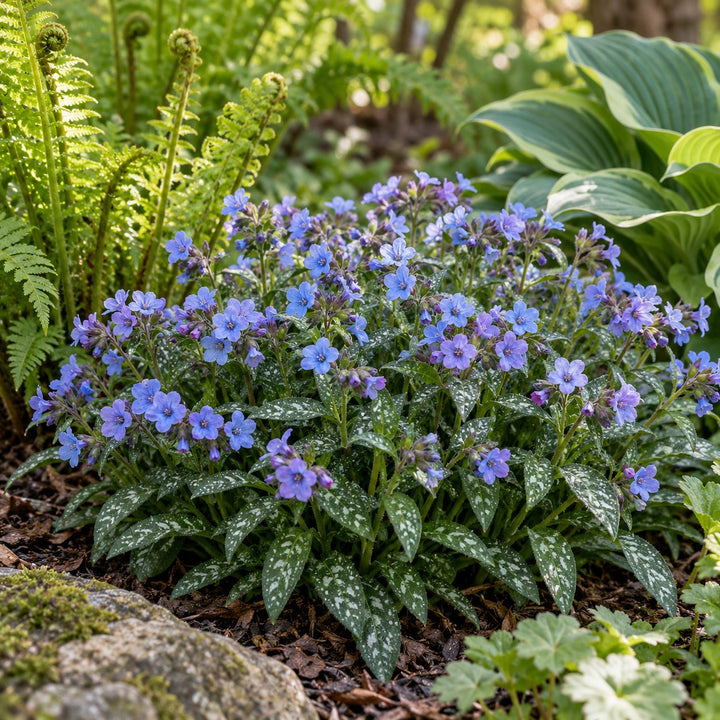
Twinkle Toes lungwort is one of the first real bursts of color in a shade garden. Pink buds open into tiny, light periwinkle-blue flowers that cover a low, tidy mound in late April and May, picking up just as hellebores wind down.
It blooms weeks before lavender even thinks about it, and it lives in the shade lavender cannot stand, so the two never compete for anything.
Twinkle Toes at a glance
| Trait | What to expect |
|---|---|
| Botanical name | Pulmonaria 'Twinkle Toes' |
| Flowers | Light periwinkle blue from pink buds, in small nodding clusters |
| Foliage | Narrow dark green leaves lightly sprinkled with silver |
| Size | 12 to 14 inches tall, 16 to 18 inches wide |
| Bloom | Late April into mid-May |
| Hardiness | USDA zones 3 to 9 |
| Light | Part shade to full shade |
| Wildlife | Good for early pollinators; deer and rabbits rarely bother it |
A spring chapter in a lavender garden
Most of a lavender garden's drama happens in June and July. Twinkle Toes gives the shady side of the same property something to say in spring. Picture lavender along the sunny front walk and, under the maple out back, a band of Twinkle Toes with hostas, ferns and brunneras behind it. The periwinkle blue is a cool cousin of lavender purple, so the two zones feel related even though they bloom months apart.
Do not try to tuck it in among the lavender. Hot afternoon sun and dry soil make its leaves scorch and wilt. Map the sun and shade on your lot in the Companion Plant Planner and give each plant its zone.
After the flowers
Once bloom finishes, cut off the old flower stems so fresh leaves fill in. The silver-flecked foliage then carries the plant through summer as a neat, low cushion, the kind of edging that makes a shady path look finished. It is compact enough for a shaded container as well.
Care through the year
- Early spring: clip away tattered old leaves before the flowers rise.
- Spring: enjoy the show; it is a single flush.
- Summer: keep it in shade from midday on and water during dry spells. Dry roots invite powdery mildew, though this cultivar was selected for good mildew resistance.
- Fall: divide crowded clumps in early fall if needed. Leaves often hang on into early winter.
- Winter: very hardy; just avoid spots that stay waterlogged.
Slugs sometimes chew the leaves in wet weather. Keeping debris cleaned up helps.
About the plug tray
Twinkle Toes is offered as a full 72-cell plug tray, enough for a woodland groundcover planting or several shady borders. See the product page for current availability.
Frequently asked questions
Why is it called lungwort?
It is an old common name for Pulmonaria, inspired by the spotted leaves. It is grown purely as an ornamental.
Can I use it as a groundcover?
Yes. Planted in groups, its low mounds knit into a tidy groundcover for shady ground.
Will it grow under trees?
Yes, as long as the soil stays evenly moist. Water it in summer dry spells, since tree roots take a lot.
















Share how it went in your field