

Use & Care NotesCompanion Plants
Bartzella Itoh Peony: A Buttery Yellow Anchor for Lavender Rows
 Save
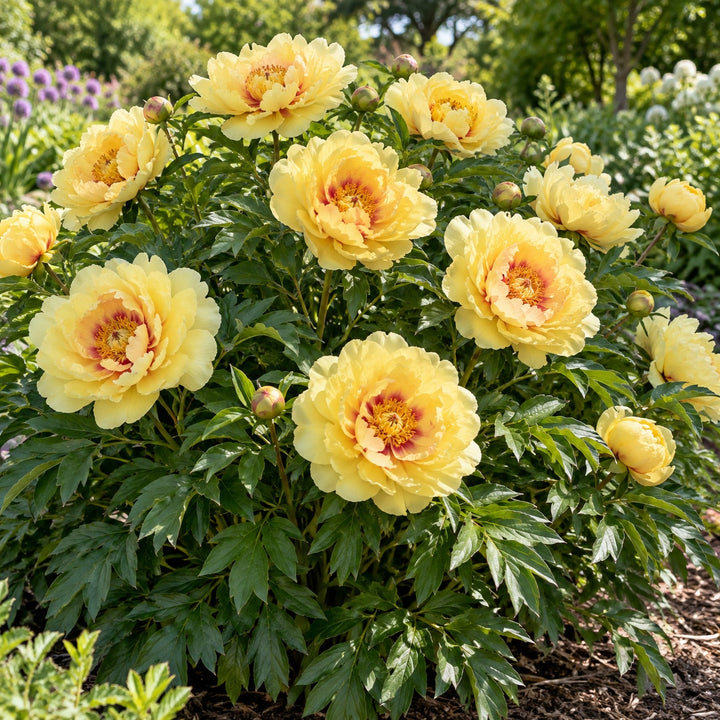
Bartzella Itoh peony is a cross between garden and tree peonies, and it took the best of both. The semi-double to double flowers reach 6 to 8 inches across in soft buttery yellow, with a small rose-purple flare at the heart and a light, sweet, slightly lemony scent.
A mature clump can carry dozens of blooms spread evenly over its top and sides, and the finely cut, tree-peony-like leaves stay handsome all season. In a lavender garden it behaves like a small shrub that happens to flower spectacularly for a few weeks.
Bartzella at a glance
| Trait | What to expect |
|---|---|
| Botanical name | Paeonia (Itoh Group) 'Bartzella' |
| Flowers | 6 to 8 inches, pastel yellow with a rose-purple center flare |
| Fragrance | Light, sweet, slightly lemony |
| Foliage | Medium to dark green, deeply divided |
| Size | About 30 to 36 inches tall and wide |
| Bloom | Starts late May, peaks early June, side buds extend it several weeks |
| Hardiness | Very cold hardy; see the listing for its zone range |
| Wildlife | Deer resistant; low pollinator value (Itoh peonies are sterile) |
Why it belongs at the end of a lavender row
Bartzella likes the same sun and good drainage as lavender. It blooms in late May and early June, just before most English lavender opens, so it hands the season off rather than competing for attention. After the flowers fade, its dome of green leaves becomes a steady backdrop for the purple spikes all summer and stays attractive into fall.
Because it grows into a 3-foot clump, it reads as structure. One at each end of a row, or a single plant at a bend in the path, frames a lavender planting nicely. Give it a bit of room so lavender beside it still gets full sun and moving air.
Planting a bare root Itoh peony
- Depth matters most: set the eyes no more than 1 to 2 inches below the soil surface. Planted too deep, peonies often refuse to bloom.
- Soil: fertile and well drained. Work in compost, but keep the crown out of standing water.
- Patience: peonies settle in slowly. Expect a few flowers at first and a much bigger show as the clump matures.
- Staking: the stems are strong, so it rarely needs support.
Care through the year
Water during dry spells in its first seasons. In damp springs, gray mold can spot buds and stems, so avoid overhead watering and keep air moving. Remove spent flowers to tidy the plant. In fall, cut the semi-woody stems back to a few inches, leaving the lower buds intact; Itoh peonies are part herbaceous and part woody, and those buds are next year's start. In hot afternoon sun the blooms fade faster, but in West Michigan full sun is usually fine.
Cutting for the vase
Bartzella is a good cut flower. Cut stems when the buds show color and feel soft like a marshmallow, and pair them with early lavender stems for a June bouquet that smells as good as it looks.
Frequently asked questions
What is an Itoh peony?
An intersectional cross between a garden peony and a tree peony. It dies partly back in winter like a garden peony but has the large flowers and cut foliage of a tree peony.
Will bees visit it?
Not much. Itoh peonies are sterile and produce no seed or pollen, so its pollinator value is low. Let the lavender handle the bees.
Do deer bother it?
It is rated deer resistant, which makes it a dependable partner for lavender in open gardens.
















Share how it went in your field