

 Open in the Field Guide
We all need a Savior
“For all have sinned and fall short of the glory of God.”
Romans 3:23 (BSB)
None of us can earn our way to God by being good enough. We all need mercy.
 Field Guide · Mammals
Tamiasciurus douglasii

A squirrel may bite if handled or cornered, so watch it from a distance.
Douglas' squirrels are small, active tree squirrels native to western North America, from the Pacific Northwest to central California, with an isolated population in northern Baja California. They live mainly in conifer forests, where they eat seeds and other plant material.
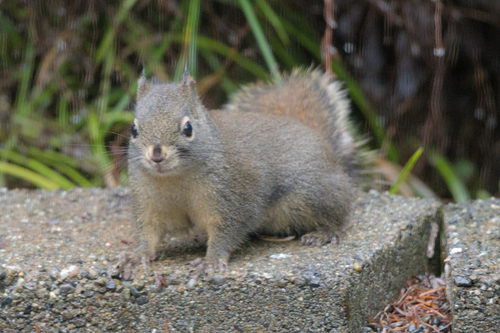
 How to recognize it
Look for a gray-brown back, orange underside, and pale ring around each eye; winter coats often have ear tufts. The American red squirrel is similar, but Douglas' squirrels are associated with western forests, while Mearns' squirrels are restricted to a small area of Baja California.
 When to see it
Douglas' Squirrel is seen most often in Jun, Jul, Aug, Sep, Oct. There are 19007 public records of it worldwide.
 Often recorded near
Public records show Douglas' Squirrel most often in the areas around these farms and places:
Seen one? Point the Lavender Passport Field Guide at it and add your find.
 Questions
It’s seen most often in Jun, Jul, Aug, Sep, Oct.
Public records show it most often around B&B Family Farm, Dockside Grill on Sequim Bay, Flatiron Fields, Graysmarsh Farm, Jardin du Soleil Lavender Farm.
Look for a gray-brown back, orange underside, and pale ring around each eye; winter coats often have ear tufts. The American red squirrel is similar, but Douglas' squirrels are associated with western forests, while Mearns' squirrels are restricted to a small area of Baja California.
A squirrel may bite if handled or cornered, so watch it from a distance.















You may also like

Here to help while we’re tending the farm