

 Open in the Field Guide
We all need a Savior
“For all have sinned and fall short of the glory of God.”
Romans 3:23 (BSB)
None of us can earn our way to God by being good enough. We all need mercy.
 Field Guide · Plants and flowers
Dipsacus fullonum

Its prickly stems and flower heads can scratch skin.
Fuller's teasel is a biennial flowering plant native to Europe, Asia, and North Africa and introduced in North America. It grows in open, disturbed places such as roadsides, fields, and vacant lots.
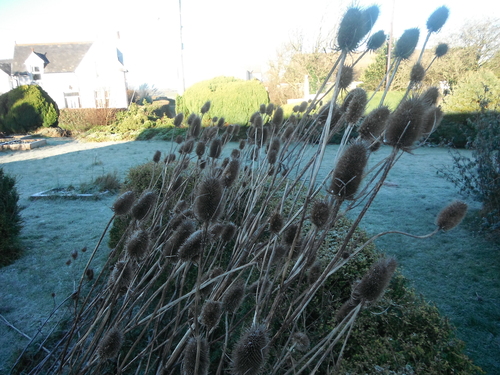
 How to recognize it
Look for tall prickly stems, opposite leaves that may form a cup around the stem, and oval heads of purple flowers with long bracts. Its purple flowers distinguish it from the typically white-flowered D. pilosus and D. laciniatus; D. sativus is a cultivated form closely related to it.
 When to see it
Fuller's Teasel is seen most often in Jun, Jul, Aug. There are 376253 public records of it worldwide.
 Often recorded near
Public records show Fuller's Teasel most often in the areas around these farms and places:
Seen one? Point the Lavender Passport Field Guide at it and add your find.
 Questions
It’s seen most often in Jun, Jul, Aug.
Public records show it most often around Bistro Maison, E.Z. Orchards, Eola Hills Wine Cellars, Harvest Fresh Grocery, Deli Catering, JB Family Growers – Lavender Farm & Flower Market.
Look for tall prickly stems, opposite leaves that may form a cup around the stem, and oval heads of purple flowers with long bracts. Its purple flowers distinguish it from the typically white-flowered D. pilosus and D. laciniatus; D. sativus is a cultivated form closely related to it.
Its prickly stems and flower heads can scratch skin.















You may also like

Here to help while we’re tending the farm