

 Open in the Field Guide
We all need a Savior
“For all have sinned and fall short of the glory of God.”
Romans 3:23 (BSB)
None of us can earn our way to God by being good enough. We all need mercy.
 Field Guide · Plants and flowers
Lamium amplexicaule
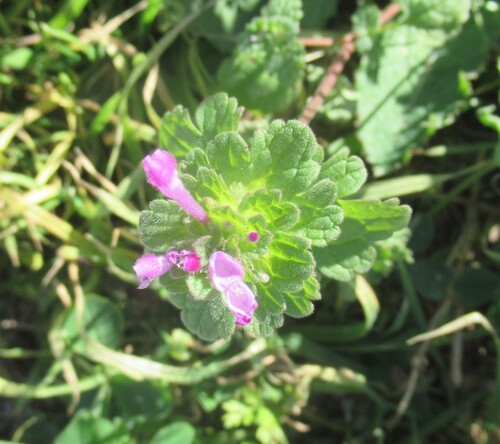
Henbit deadnettle is a low-growing annual in the mint family, native to Europe, Asia, and northern Africa and now common in many parts of North America. It grows in lawns, gardens, fields, and other disturbed places, often appearing in early spring.
 How to recognize it
Its rounded, scalloped upper leaves clasp the stem, and small pink-purple flowers grow in clusters near the top; unlike purple deadnettle, its upper leaves are not usually reddish and triangular. It is also smaller-flowered than white deadnettle and spotted deadnettle, whose flowers are white or often marked with spots.
 In lavender fields
Henbit can grow as a garden weed, and its early-season flowers provide nectar for bees that may also visit lavender.
 When to see it
Henbit Deadnettle is seen most often in Mar, Apr. There are 231289 public records of it worldwide.
 Often recorded near
Public records show Henbit Deadnettle most often in the areas around these farms and places:
Seen one? Point the Lavender Passport Field Guide at it and add your find.
 Questions
It’s seen most often in Mar, Apr.
Public records show it most often around Honey Creek Farm, Merritt's Bakery, Merritt's Bakery, Five Oaks Lodge, Oklahoma Animal Alliance.
Its rounded, scalloped upper leaves clasp the stem, and small pink-purple flowers grow in clusters near the top; unlike purple deadnettle, its upper leaves are not usually reddish and triangular. It is also smaller-flowered than white deadnettle and spotted deadnettle, whose flowers are white or often marked with spots.





You may also like

Here to help while we’re tending the farm