

 Open in the Field Guide
We all need a Savior
“For all have sinned and fall short of the glory of God.”
Romans 3:23 (BSB)
None of us can earn our way to God by being good enough. We all need mercy.
 Field Guide · Pollinators
Bombus terrestris

Females can sting if handled or if their nest is disturbed, so give them space.
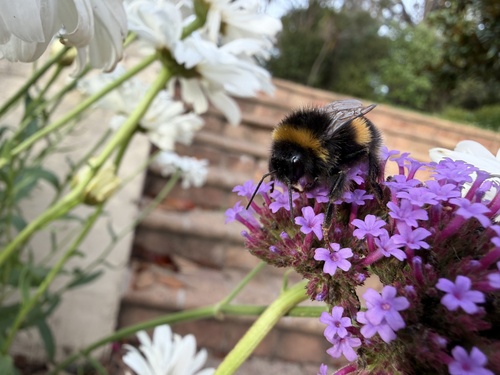
The buff-tailed bumblebee is a social bee native to Europe, northern Africa, and parts of western Asia. It lives in varied open habitats, including gardens and farmland, and has also been introduced to some regions outside its native range.
 How to recognize it
It is a robust, fuzzy bee with yellow bands and a pale tail; queens often have a buff-colored tail, while workers may have a whitish one. Its tail and body pattern help distinguish it from the brownish B. pascuorum and red-tailed B. lapidarius and B. pratorum, but it can be hard to tell from B. impatiens by color alone.
 In lavender fields
It visits lavender flowers for nectar and pollen and can pollinate them.
 When to see it
Buff-tailed Bumblebee is seen most often in Jun, Jul. There are 649715 public records of it worldwide.
 Often recorded near
Public records show Buff-tailed Bumblebee most often in the areas around these farms and places:
Seen one? Point the Lavender Passport Field Guide at it and add your find.
 Questions
It’s seen most often in Jun, Jul.
Public records show it most often around Amisfield Winery & Bistro, Cardrona Distillery, Cardrona Hotel, Chard Farm, Gibbston Valley Winery.
It is a robust, fuzzy bee with yellow bands and a pale tail; queens often have a buff-colored tail, while workers may have a whitish one. Its tail and body pattern help distinguish it from the brownish B. pascuorum and red-tailed B. lapidarius and B. pratorum, but it can be hard to tell from B. impatiens by color alone.
Females can sting if handled or if their nest is disturbed, so give them space.















You may also like

Here to help while we’re tending the farm