

 Open in the Field Guide
We all need a Savior
“For all have sinned and fall short of the glory of God.”
Romans 3:23 (BSB)
None of us can earn our way to God by being good enough. We all need mercy.
 Field Guide · Plants and flowers
Baccharis pilularis
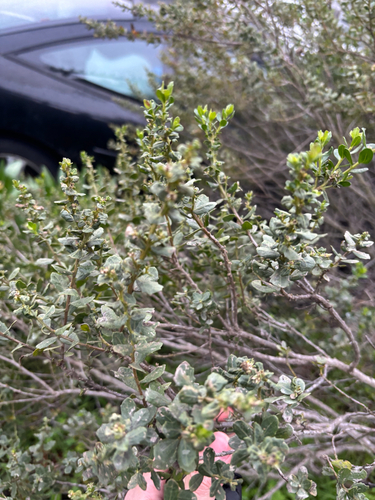
Coyote brush is an evergreen shrub native to the West Coast, from Washington and Oregon through California to Baja California. It grows in coastal scrub, chaparral, and other open habitats, and its small flowers grow on separate male and female plants.
 How to recognize it
It is often a dense, rounded shrub with small leaves that can be toothed or smooth-edged. Compared with the listed relatives, it usually has smaller leaves than B. halimifolia, while B. salicifolia has narrower, willowlike leaves and B. sarothroides has slender, broomlike stems; B. trinervis is generally a climbing shrub with three prominent leaf veins.
 When to see it
Coyote Brush is seen most often in Apr, Sep, Oct, Nov. There are 37902 public records of it worldwide.
 Often recorded near
Public records show Coyote Brush most often in the areas around these farms and places:
Seen one? Point the Lavender Passport Field Guide at it and add your find.
 Questions
It’s seen most often in Apr, Sep, Oct, Nov.
Public records show it most often around Battaglini Estate Winery, David Coffaro Vineyard, Dry Creek Vineyard, Frick Wine Store, Hook & Ladder Winery.
It is often a dense, rounded shrub with small leaves that can be toothed or smooth-edged. Compared with the listed relatives, it usually has smaller leaves than B. halimifolia, while B. salicifolia has narrower, willowlike leaves and B. sarothroides has slender, broomlike stems; B. trinervis is generally a climbing shrub with three prominent leaf veins.















You may also like

Here to help while we’re tending the farm