

 Open in the Field Guide
We all need a Savior
“For all have sinned and fall short of the glory of God.”
Romans 3:23 (BSB)
None of us can earn our way to God by being good enough. We all need mercy.
 Field Guide · Mushrooms
Amanita phalloides

Eating even a small amount can cause fatal poisoning; do not eat wild mushrooms.
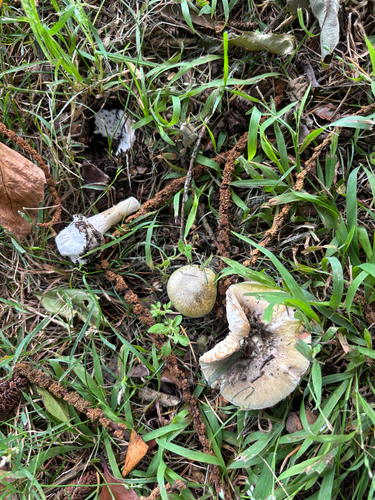
The death cap is a poisonous mushroom native to Europe and introduced in parts of North America. It grows in summer and fall, usually near broadleaf trees such as oaks, whose roots it joins in a mutually beneficial relationship.
 How to recognize it
It often has an olive-green cap, white gills, a ring on the stem, and a cup-like sac at the stem base; these features help distinguish it from the red-capped Amanita muscaria and the reddish-staining A. rubescens. Cap color varies, and it can be difficult to distinguish from other Amanita species, so appearance alone is not a safe basis for identification.
 When to see it
Deathcap is seen most often in Sep, Oct. There are 39300 public records of it worldwide.
 Often recorded near
Public records show Deathcap most often in the areas around these farms and places:
Seen one? Point the Lavender Passport Field Guide at it and add your find.
 Questions
It’s seen most often in Sep, Oct.
Public records show it most often around Battaglini Estate Winery, David Coffaro Vineyard, Dry Creek Vineyard, Frick Wine Store, Hook & Ladder Winery.
It often has an olive-green cap, white gills, a ring on the stem, and a cup-like sac at the stem base; these features help distinguish it from the red-capped Amanita muscaria and the reddish-staining A. rubescens. Cap color varies, and it can be difficult to distinguish from other Amanita species, so appearance alone is not a safe basis for identification.
Eating even a small amount can cause fatal poisoning; do not eat wild mushrooms.















You may also like

Here to help while we’re tending the farm