

 Open in the Field Guide
We all need a Savior
“For all have sinned and fall short of the glory of God.”
Romans 3:23 (BSB)
None of us can earn our way to God by being good enough. We all need mercy.
 Field Guide · Spiders
Argiope trifasciata

It may bite if handled, but bites are uncommon and generally cause only mild, brief pain or irritation.
The banded garden spider is an orb-weaving spider found in open, sunny places such as fields, grasslands, and gardens. It builds a circular web among vegetation and is widespread in North America.
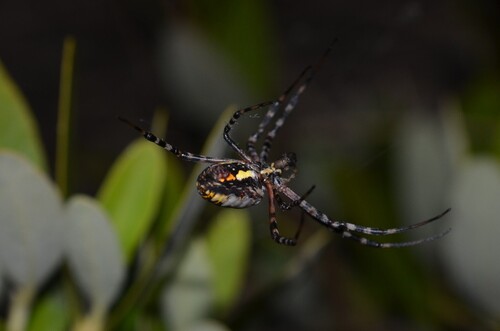
 How to recognize it
Its abdomen has repeated narrow bands of yellow, black, and silvery white; this fine striping differs from the bolder patterns of A. aurantia and A. bruennichi, while A. argentata is more silver-dominant and A. keyserlingi is chiefly found in Australia. Females are much larger and more conspicuous than males.
 In lavender fields
It has no special association with lavender, but may spin a web among lavender plants and catch insects flying nearby.
 When to see it
Banded Garden Spider is seen most often in Sep. There are 35985 public records of it worldwide.
 Often recorded near
Public records show Banded Garden Spider most often in the areas around these farms and places:
Seen one? Point the Lavender Passport Field Guide at it and add your find.
 Questions
It’s seen most often in Sep.
Public records show it most often around À la Croisée des Pommes, Asteur, Cidrerie Lacroix, Intermiel, La Lavandoise.
Its abdomen has repeated narrow bands of yellow, black, and silvery white; this fine striping differs from the bolder patterns of A. aurantia and A. bruennichi, while A. argentata is more silver-dominant and A. keyserlingi is chiefly found in Australia. Females are much larger and more conspicuous than males.
It may bite if handled, but bites are uncommon and generally cause only mild, brief pain or irritation.















You may also like

Here to help while we’re tending the farm