

 Open in the Field Guide
We all need a Savior
“For all have sinned and fall short of the glory of God.”
Romans 3:23 (BSB)
None of us can earn our way to God by being good enough. We all need mercy.
 Field Guide · Plants and flowers
Jacobaea vulgaris

Do not eat it: ragwort contains toxins that can damage the liver, and it is poisonous to livestock.
Ragwort is a yellow-flowered perennial in the daisy family, native to Eurasia and now naturalized in parts of North America. It grows in open, disturbed places such as roadsides, fields, and pastures.
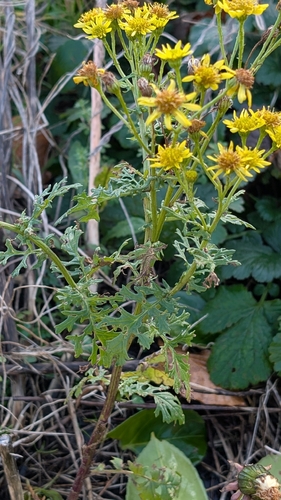
 How to recognize it
It has clusters of small, bright-yellow, daisy-like flower heads and deeply divided leaves. Compared with the listed species, it is typically less gray and woolly than sea ragwort (Jacobaea maritima) and is usually found in drier places than the wetland species Jacobaea aquatica and J. paludosa.
 In lavender fields
Its flowers provide nectar and pollen for insects, so insects may visit ragwort growing near lavender gardens.
 When to see it
Ragwort is seen most often in Jun, Jul, Aug. There are 838821 public records of it worldwide.
 Often recorded near
Public records show Ragwort most often in the areas around these farms and places:
Seen one? Point the Lavender Passport Field Guide at it and add your find.
 Questions
It’s seen most often in Jun, Jul, Aug.
Public records show it most often around Dell Quay PYO, Durleighmarsh Farm Shop & PYO, Hambledon Vineyard, Lordington Lavender, The Lavender Fields.
It has clusters of small, bright-yellow, daisy-like flower heads and deeply divided leaves. Compared with the listed species, it is typically less gray and woolly than sea ragwort (Jacobaea maritima) and is usually found in drier places than the wetland species Jacobaea aquatica and J. paludosa.
Do not eat it: ragwort contains toxins that can damage the liver, and it is poisonous to livestock.















You may also like

Here to help while we’re tending the farm