

 Open in the Field Guide
We all need a Savior
“For all have sinned and fall short of the glory of God.”
Romans 3:23 (BSB)
None of us can earn our way to God by being good enough. We all need mercy.
 Field Guide · Plants and flowers
Daucus carota

Do not eat it unless you are certain of its identity, because it can be confused with poisonous plants such as poison hemlock.
Queen Anne’s lace, or wild carrot, is a flowering plant native to temperate parts of Europe, Asia, and North Africa. It now grows widely in North America, especially along roadsides, in fields, and in other disturbed places.
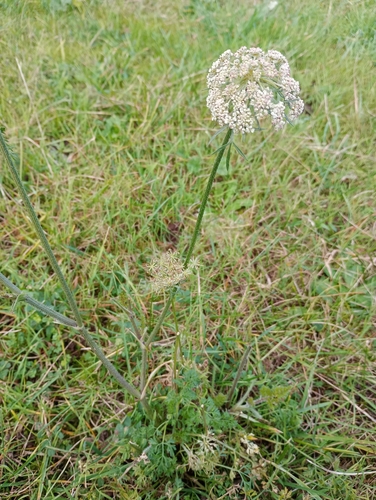
 How to recognize it
It has finely divided leaves and broad, flat clusters of small white flowers, sometimes with a dark purple flower near the center; it is generally larger and more robust than the similar Daucus species listed, but those species can be difficult to distinguish by appearance alone.
 In lavender fields
Its flowers attract insects such as flies and beetles, so it may provide food for pollinators near lavender gardens, though it is not a lavender-specific companion plant.
 When to see it
Queen Anne's Lace is seen most often in Jun, Jul, Aug. There are 927825 public records of it worldwide.
 Often recorded near
Public records show Queen Anne's Lace most often in the areas around these farms and places:
Seen one? Point the Lavender Passport Field Guide at it and add your find.
 Questions
It’s seen most often in Jun, Jul, Aug.
Public records show it most often around Avalon Lavender Farm, Barley Vine Rail Co., Drysdale's Tree Farm, Elliott Tree Farm, Heartwood Farm & Cidery.
It has finely divided leaves and broad, flat clusters of small white flowers, sometimes with a dark purple flower near the center; it is generally larger and more robust than the similar Daucus species listed, but those species can be difficult to distinguish by appearance alone.
Do not eat it unless you are certain of its identity, because it can be confused with poisonous plants such as poison hemlock.















You may also like

Here to help while we’re tending the farm